
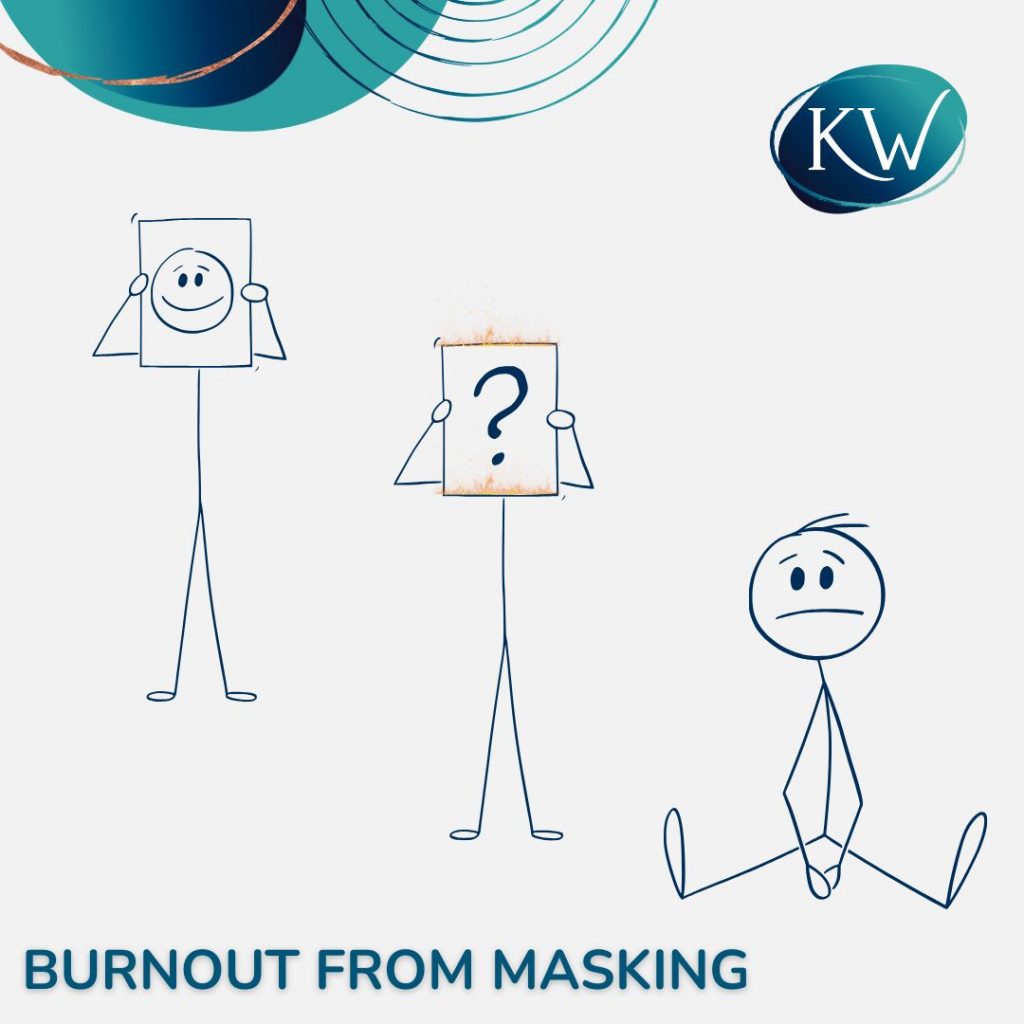
Can Therapy Help With Burnout From Masking?
The short answer is yes. But there’s a longer answer (I have ADHD and I’m an over-explainer – there is always a longer answer!)
It's worth explaining what the therapeutic process actually looks like, because therapy for burnout from masking isn't about being given a set of tools and being sent on your way. It's something slower, deeper and in my professional experience, considerably more transformative than that.
How does burnout from masking, develop?
For many neurodivergent adults, masking starts early. Autists, ADHDers and otherwise neurodivergent people learnt to practice masking in a world that didn’t have enough understanding of neurodiversity and the rather obvious truth that human brains differ.
Masking is a trauma response created to protect us from pain. Pain in many forms through criticism, judgement, bullying, emotional and physical neglect and abuse. When you learn (unconsciously) to mask, you learn to read the room, anticipate reactions and to perform a version of yourself that makes you feel safer.
It starts as survival strategy. And for a while, sometimes even years, it works.
But masking is expensive. It costs enormous amounts of cognitive and emotional energy. Over time, stress builds. Anxiety embeds, sleep deteriorates. The inner critic gets louder. And underneath it all, a creeping disconnection further and further away from who you really are.
And that’s when you hit burnout. It accumulates quietly over the years until one day, you reach the edge of your capacity to cope with the strain.
What does therapy do?
When someone comes to me in a state of burnout, the instinct (theirs and sometimes mine too) is to find quick fixes. You want out of the pain; I want you out of pain too. And of course, we do need to get some things in place asap, but they're not the only starting point.
We start with the roots.
Therapy is first and foremost a space for curiosity. Together, we begin to explore the beginnings; where the seeds of masking were sown. Childhood, school, friendships, relationships, previous life experiences. Those moments when the message arrived, in whatever form it took, that the authentic version of you wasn't quite right.
This isn't about blame or dwelling in the past. It's about context. Because without understanding where something started, it's very hard to know what you're actually working with.
From exploration, we develop insights. A growing self-awareness that begins to make sense of things.
‘This is not who I am; this is what I learned to do in order to feel safe.’
Understanding where it all came from, this is the work in the roots.
Building the toolkit
Once the roots are understood, the work moves into something more practical and forward-looking, towards growth, but without abandoning the emotional depth of the roots work. Keeping those insights in mind is an important part of the next steps.
Together, we develop strategies. Not a one-size-fits-all approach, but a varied, personal toolkit of ideas, approaches and practices. Something built specifically for your life, your triggers, your nervous system, your environment.
These strategies are practised and refined, over and over again. Over time they become embedded, and the distance between activation and recovery reduces. Old patterns of shame, anxiety and maladaptive coping, start to loosen their grip. Burnout doesn’t disappear overnight and life still throws curveballs. But with self-awareness and a varied toolkit, your capacity to navigate and recover improves.
What becomes possible?
Therapy for masking burnout isn't a quick fix and I'd be doing you a disservice to suggest otherwise. It takes time, a good therapeutic relationship and a willingness to look at things that are sometimes uncomfortable.
With these in place, you can gain a clearer sense of who you are beneath the mask. A more compassionate relationship with yourself. Strategies that genuinely work for your unique brain. And a gradually increasing distance between you and the burnout that brought you here in the first place.
If you're neurodivergent, exhausted and wondering whether something needs to change, the answer is probably yes. And you don't need to have it all figured out before you reach out. Sometimes the first step is simply a conversation.